Want this set up for your business?
Hermes Agent alternatives are worth comparing before you move real work into an autonomous agent. Hermes is getting attention because it is self-hosted, skill-driven, and designed to learn from repeated use, but that does not automatically make it the best fit for a business workflow.
The better question is practical: who will run the agent, where will it live, what systems can it touch, and what happens when it makes the wrong call? That is where the choice gets clearer.
Hermes can be a strong option for technical users who want a personal agent that grows over time. OpenClaw is usually the better choice when the priority is business operations, channel routing, repeatable automations, and setup that can be handed off cleanly. Claude Desktop, Claude Code, n8n, and managed agent tools can also make sense depending on the job.
Hermes Agent Alternatives Start With The Use Case
Do not start by asking which agent is most powerful. Start with the workflow. A founder who wants daily customer follow-up needs a different setup than a developer who wants an agent to maintain repo context across long coding sessions.
Hermes Agent’s public documentation positions it as a self-improving AI agent with a learning loop, persistent memory, and a skill system. The GitHub project also describes migration support from OpenClaw, including detection of an existing ~/.openclaw setup during first-time configuration. That matters because Hermes is not just another chatbot wrapper. It is aiming at the same local-agent category.
But there is a catch. The more an agent learns, remembers, and edits its own working patterns, the more important your governance model becomes. I like the ambition. I would still be careful about giving a learning agent broad access to business systems before the permissions, logging, and recovery path are boringly clear.
Need help choosing the right agent stack?
Get a practical setup plan before you connect inboxes, calendars, CRMs, or team channels.
Hermes Agent Alternatives For Business Operations
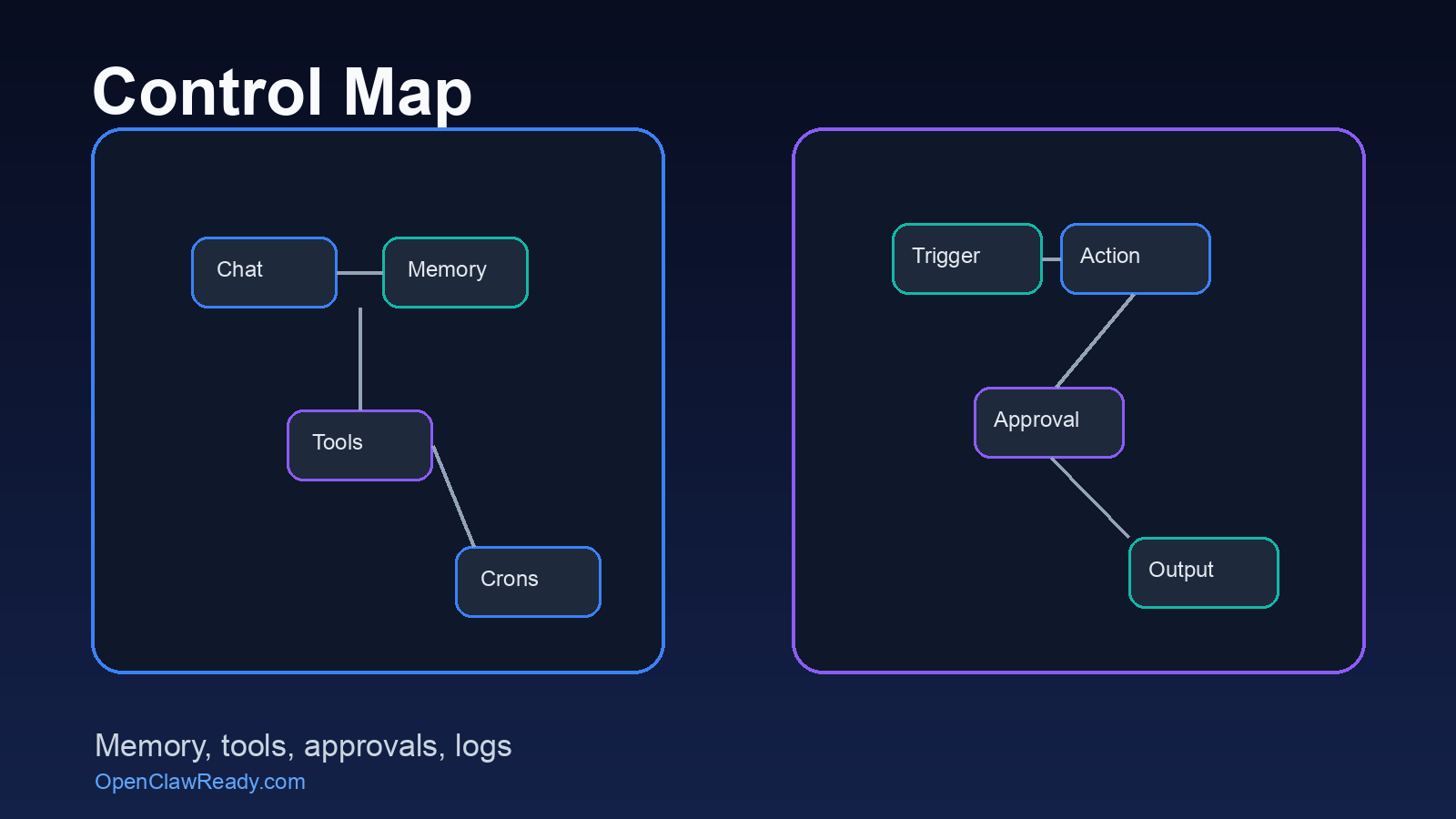
If your goal is business automation, OpenClaw is the first alternative to evaluate. It is built around local control, skills, crons, memory, messaging channels, and repeatable workflows. That combination is useful when the work is not just “answer this prompt” but “watch this channel, route this task, remember the decision, and run the next step tomorrow.”
For a deeper platform comparison, read Hermes Agent vs OpenClaw. The short version: Hermes is interesting when the learning loop is the main attraction. OpenClaw is stronger when the workflow needs clear boundaries, channel routing, and operational control.
This is also why the best alternative may be different for the same company at different stages. A founder can test Hermes on personal research without much risk. The same founder may want OpenClaw when the agent starts touching sales follow-up, support triage, task routing, or daily reporting. The risk profile changes once the workflow leaves a private sandbox.
A business owner should care about mundane things:
- Can the agent run on the machine or server you actually maintain?
- Can it use the tools your team already lives in?
- Can you inspect what happened after a bad run?
- Can you separate risky actions from low-risk summaries?
- Can someone else take over the setup if the original builder disappears?
That last point sounds unglamorous. It is also where many AI agent experiments break. A clever personal setup is not the same thing as a maintainable business system.
OpenClaw As A Hermes Agent Alternative
OpenClaw is the cleanest Hermes Agent alternative when you want a self-hosted agent that can become part of the operating system of a small business. It is especially useful for founders, agencies, recruiters, real estate teams, and service businesses that need task routing across messaging, calendars, documents, and client follow-up.
The best OpenClaw setups usually have a few pieces in place before the agent touches important work: a clear OpenClaw setup checklist, permission boundaries, known escalation rules, and a small number of recurring workflows. Start there. Do not begin with twenty automations because twenty sounds impressive.
OpenClaw also has a mature skills pattern. Skills are useful because they let the agent load task-specific instructions only when needed. That keeps the system more organized than stuffing every rule into one giant prompt. If you are comparing this against Hermes, look at how each platform handles skill storage, skill loading, and skill updates.
There is one nuance: OpenClaw takes setup discipline. If you want a polished consumer app where everything is abstracted away, it may feel heavy. But if you want control over where memory lives, which channels can trigger work, and what the agent is allowed to do, that setup time is part of the value.
Claude Desktop, Claude Code, And Local Coding Agents
Claude Desktop and Claude Code are different kinds of alternatives. They are not direct replacements for a 24/7 business agent, but they may beat Hermes for specific work.
Claude Desktop is a good fit when the workflow is mostly interactive: research, drafting, document review, lightweight analysis, or working with files through a configured local environment. It can feel simpler because the human stays close to the loop.
Claude Code is better when the real job is software engineering. If the agent needs to read a repo, edit files, run tests, and explain failures, a coding-focused CLI often makes more sense than a general personal agent. Hermes can route into coding tools through skills, but that does not mean Hermes itself is the best center of gravity for engineering work.
For business teams, the honest answer may be a hybrid. Use OpenClaw for recurring operations. Use Claude Code for repo work. Use Claude Desktop for human-in-the-loop analysis. The mistake is trying to make one agent do every job just because it can technically touch every job.
Turn the comparison into a setup plan.
Map the workflows, choose the agent roles, and avoid a fragile all-in-one build.
Managed Agent Tools As Hermes Agent Alternatives
Managed tools are worth considering when control matters less than speed. If a team wants the fastest path to a simple assistant, a hosted product can remove the server, terminal, credential storage, and maintenance burden.
The tradeoff is lock-in. Managed tools often hide the operational layer that technical teams eventually want to inspect. That can be fine for low-risk workflows like drafting, classification, and internal summaries. It gets less fine when the agent can send messages, change records, or trigger customer-facing actions.
n8n, Zapier, Make, and similar automation platforms are not the same as agent frameworks, but they can be smarter choices for deterministic work. If the workflow is “when this form arrives, update this CRM field, then notify this Slack channel,” you may not need an autonomous agent at all. You may need a clean automation with one AI step in the middle.
That is the boring answer. It is often the correct one.
How To Choose Between Hermes Agent Alternatives
Use a simple decision filter.
Choose Hermes Agent when you are technical, you want a self-hosted personal agent, and the learning loop is central to the value. It is especially interesting for users who want the agent to build memory and reusable skills from repeated work.
Choose OpenClaw when you need a business automation agent with channel routing, crons, tool workflows, and a setup that can be governed. If you are building around operations instead of experimentation, start with OpenClaw. The OpenClaw vs AgentGPT comparison is useful if you want a broader view of agent control tradeoffs.
Choose Claude Code when the agent’s job is engineering. Keep the coding loop inside a coding-first tool.
Choose managed automation tools when the task is predictable and the team does not want to maintain local infrastructure.
The main thing is to avoid vague “AI assistant” goals. Name the job. Name the trigger. Name the system of record. Name the failure mode. Once you do that, the right alternative usually becomes obvious.
Final Recommendation On Hermes Agent Alternatives
If you are experimenting personally, Hermes Agent deserves a serious look. Its learning model is the interesting part, and the project is clearly pushing the local-agent category forward.
If you are setting up business automation, OpenClaw is the safer starting point for most teams. It is easier to reason about as an operating layer: skills, memory, channels, crons, and human escalation can be planned before the agent gets access to live work.
Do the comparison with a workflow map in front of you. A tool that looks strongest in a demo can still be wrong for your actual business if it hides too much, learns in ways you cannot audit, or expects a technical owner to stay permanently attached to the setup.
Build the agent stack around real work.
Get help choosing, configuring, and hardening the right OpenClaw setup for your workflow.