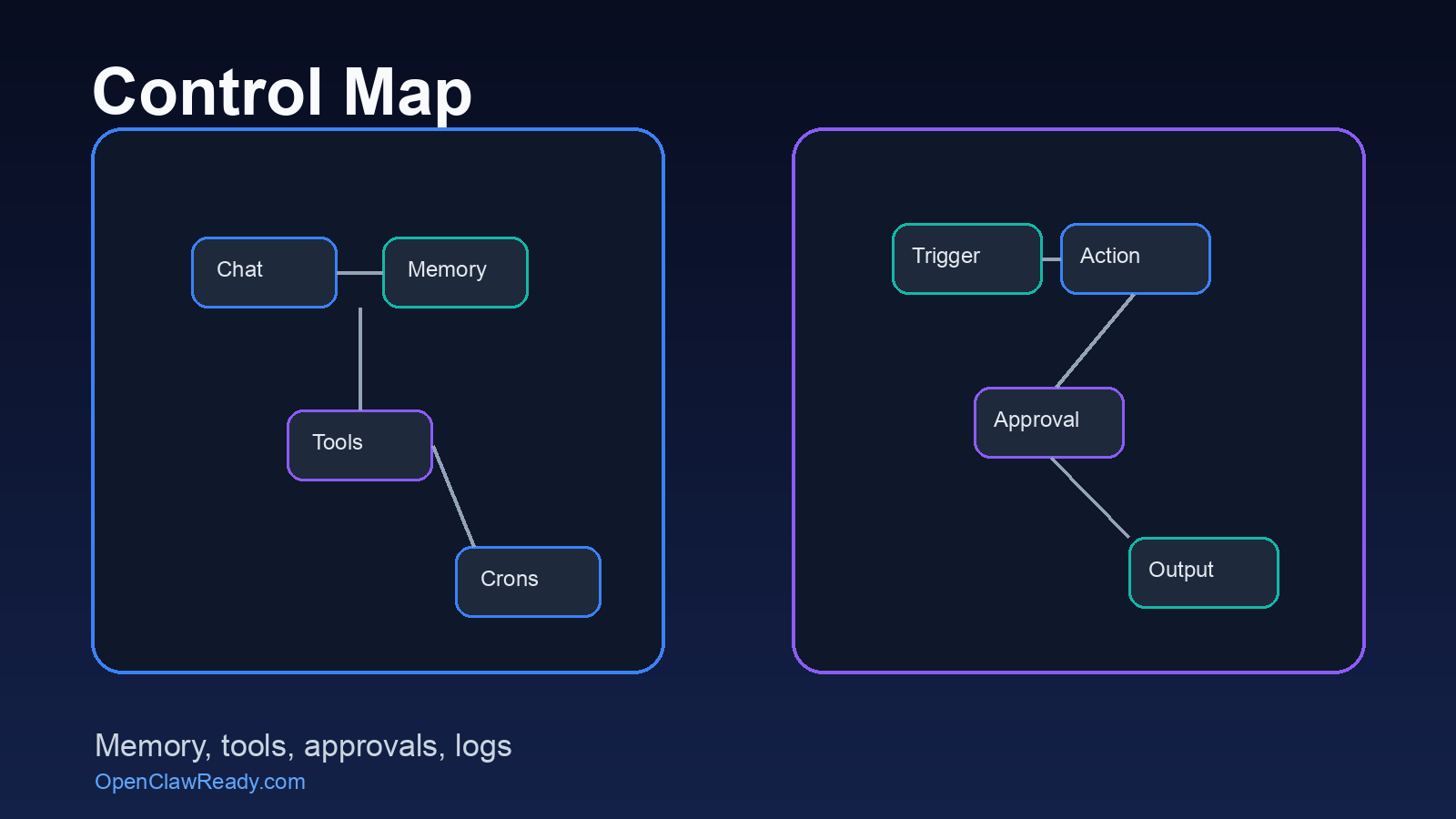
Want this set up for your business?
Hermes agent vs OpenClaw is the comparison a lot of technical business owners are making right now. Both sit in the same general world: persistent AI agents, local or self-hosted control, skills, memory, and tool use. But they are not trying to solve the exact same problem.
Hermes is attractive if you want one assistant that learns from repeated work and improves its own procedures over time. OpenClaw is the better fit when the job is broader: multiple agents, channel routing, crons, handoffs, business workflows, and a setup that other people on the team can trust.
The honest answer is not “one wins.” The better question is where the work will live after the first impressive demo. If the system has to run customer follow-up, inbox triage, internal alerts, content operations, or recurring admin without constant babysitting, setup quality matters more than novelty.
Hermes Agent vs OpenClaw: The Short Version
Hermes Agent is best understood as a single self-improving assistant. Public Nous Research docs describe Hermes skills as on-demand knowledge documents, and the project positions Hermes around a learning loop: it can create and improve skills from experience, search past conversations, and keep a persistent model of the user’s preferences across sessions.
OpenClaw is different. It is a multi-agent operating setup for real work. Instead of asking one assistant to remember everything and do everything, OpenClaw can separate roles, skills, schedules, memory, approval rules, and message channels. That structure is less flashy in a demo, but it is exactly what business workflows usually need.
So the practical split looks like this: choose Hermes when you want a personal assistant that gets better through repeated use. Choose OpenClaw when you need a controlled agent system with recurring tasks, multiple workflows, and clearer operating boundaries.
Need Help Choosing the Right Agent Setup?
We can map the workflows you actually need before you commit to a stack.
Where Hermes Agent Feels Strong
Hermes has a clean pitch: one agent that grows with you. That matters. A lot of AI assistants fail because every session feels like a reset. The user keeps explaining the same context, the same preferences, and the same operating rules. Hermes tries to reduce that by making learning part of the product.
Its skill system is the biggest reason people are paying attention. The official Hermes docs describe skills as focused workflow instructions that can be listed, installed, created, and loaded on demand. Hermes also supports bundled skills, optional skills, and direct GitHub skill installs, which gives technical users a flexible path for extending the agent.
That makes Hermes appealing for solo operators, developers, and AI-heavy users who are comfortable tuning an assistant through repeated use. If your goal is “I want one agent that understands how I work,” Hermes is a serious option.
But there is a catch. A system that learns from experience still needs boundaries. Self-improvement is useful only when the agent is learning the right thing, storing the right memory, and not turning one messy workflow into a permanent habit. That is where non-technical teams can get into trouble.
Where OpenClaw Fits Better
OpenClaw is stronger when the workflow has moving parts. Think inbox monitoring, Slack or Discord routing, recurring reports, customer support triage, CRM updates, lead follow-up, calendar coordination, or content operations. Those jobs usually need more than one smart assistant.
They need roles. They need rules. They need a place for durable memory, a place for temporary task state, and a way to separate private work from public updates. They also need boring verification steps: did the post publish, did the alert send, did the item land in the right channel, did the agent stop when approval was required?
This is why OpenClaw pairs well with structured setup work. A good setup is not just installing a tool. It is deciding which tasks should run automatically, which tasks need human approval, which channels should receive output, and which failures should stay quiet until they become actionable.
If you are still early, read the OpenClaw setup checklist before building anything complicated. It gives you the order of operations most teams skip.
Hermes Agent vs OpenClaw for Setup Work
Setup is where the comparison gets more practical. Hermes can be fast to experiment with if you already know what you want the agent to do. OpenClaw takes more upfront thinking because the system can handle more operating surfaces.
That upfront work can feel slower. It is also the part that prevents painful rebuilds later.
For a business owner, the setup question is not “which tool has more features?” It is “which setup will still make sense after ten messy real-world tasks?” A useful agent stack has to answer four questions before it earns trust.
- What work is safe to automate without approval?
- Where does the agent store facts, preferences, and current task state?
- Which tools can the agent touch, and under what limits?
- How does the system report success, failure, and skipped work?
That last question is easy to underrate. Quiet skips are healthy when nothing needs attention. Loud failures are useful when a broken credential, missing image, bad API response, or unclear approval step needs a human. The worst setup is the middle zone where the agent posts noise all day, then stays silent when the real failure happens.
OpenClaw setup work should define those behaviors before launch. Hermes can still be useful inside that environment, but the business workflow needs a system of record for what happened, what changed, and what should happen next.
Hermes can handle a lot of personal workflow improvement when the user stays close to the agent. OpenClaw is better when the process needs to be shared, audited, scheduled, or routed across business channels.
Turn the Comparison Into a Setup Plan
Bring the workflows. We will help decide what belongs in OpenClaw, Hermes, or neither.
How to Decide Without Overbuilding
Start with the work, not the agent. Most bad AI setups begin with tool excitement and end with a pile of half-connected automations. The better path is to pick one workflow that hurts every week and define the handoff clearly.
For example, a founder might want help with inbound leads. Hermes could become the founder’s personal research and drafting assistant. OpenClaw could route new lead notifications, enrich the CRM record, draft follow-up, and ask for approval before anything client-facing goes out. Those are different jobs.
Or take internal reporting. Hermes might be useful for a personal operating brief. OpenClaw is stronger when the report needs to run on a schedule, pull from multiple tools, post into the right channel, and avoid noisy updates when nothing changed.
There is also a hybrid answer. Some technical teams may run Hermes for personal learning and OpenClaw for business orchestration. That can work if the boundary is explicit. It gets messy when both agents can edit the same memory, trigger the same tools, or speak into the same channels without clear rules.
If your main concern is choosing the right automation layer, compare this article with OpenClaw vs Zapier. The same principle applies: the winner depends on whether you need simple triggers or agent-level judgment.
Common Mistakes When Comparing Agent Tools
The first mistake is treating every agent as a chatbot with more permissions. That misses the real difference. The hard part is not getting an agent to answer. The hard part is getting it to do useful work repeatedly, with context, restraint, and recovery paths.
The second mistake is judging only by installation speed. A quick install is nice, but a clean operating model matters more. If the agent needs access to email, CRM, calendars, file storage, messaging, or publishing tools, you need a permissions plan before you need another demo.
The third mistake is skipping maintenance. Skills go stale. Memories get messy. Business rules change. Someone has to own the setup after launch. This is the unglamorous part of agent work, but it is where most value is either protected or lost.
For a deeper look at where setups break, use OpenClaw setup mistakes as a preflight check.
Final Take: Pick the Operating Model
Hermes agent vs OpenClaw is really a choice between two operating models. Hermes is compelling as a personal, self-improving agent that learns from repeated work. OpenClaw is stronger when the goal is a controlled business automation system with multiple agents, routing, schedules, and setup discipline.
If you are a solo technical user, Hermes deserves a look. If you are building workflows that affect customers, revenue operations, support, publishing, or team coordination, OpenClaw is usually the sturdier foundation.
And if you are unsure, that uncertainty is useful. It means you should not start by installing another agent. Start by writing down the workflow, the approval points, the tools involved, and what failure would look like. The right setup will become much easier to see.
Get a Practical Agent Setup Recommendation
We will help you choose the stack, boundaries, and first workflow to build.