The openclaw vs n8n question comes up often when small business owners start looking at automation. Both tools are self-hostable, both handle complex workflows, and both sit in a category that did not really exist five years ago. But they solve different problems, and choosing the wrong one will cost you time you do not have.
This comparison cuts through the marketing language and gives you a direct answer: what each tool actually does, where each one falls short, and which one belongs in your stack.
What n8n Actually Is
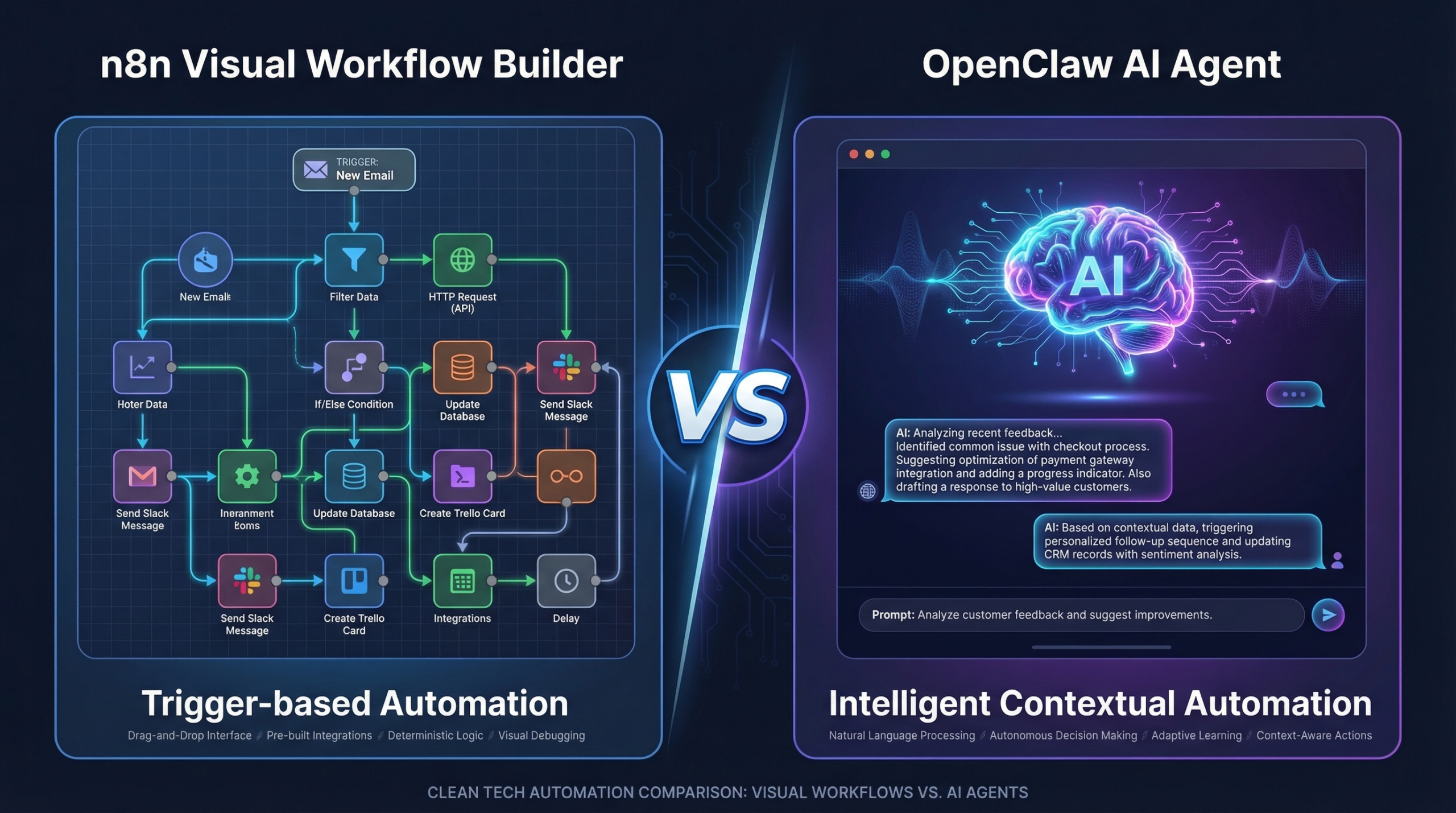
n8n is a visual workflow automation tool. You drag nodes onto a canvas, connect them with arrows, and define triggers and actions. When Trigger A fires, Action B runs, then Action C, and so on.
The node library is large. n8n connects to over 400 applications out of the box – Google Sheets, Slack, HubSpot, Stripe, Postgres, and hundreds more. You can pull data from a webhook, transform it with JavaScript, push it to a CRM, and send a Slack notification, all in one canvas.
It ships as open-source software (source-available, specifically) with a self-hosted community edition that is free. There is also a managed cloud version with a subscription that scales by the number of workflow executions per month. The self-hosted path gives full data control but requires you to maintain a server.
n8n has been around since 2019. The documentation is thorough, the community forum is active, and there are thousands of workflow templates available. For teams that want to automate well-defined, repeatable processes across multiple SaaS tools, it is a proven choice.
What OpenClaw Actually Is
OpenClaw is an AI agent platform. Not a visual workflow builder – an agent. You give it instructions, context, and access to tools, and it reasons its way through tasks using Claude under the hood.
The core difference from n8n is persistence. OpenClaw maintains memory across sessions. It knows what happened yesterday, what you asked it last week, and what the status of an ongoing project is. That context lives in files on your server and gets loaded into every session automatically.
Instead of nodes, OpenClaw uses skills – modular plugins that give the agent specific capabilities like publishing to WordPress, querying a database, or posting to Discord. Instead of visual triggers, it uses cron jobs: scheduled tasks that fire on a time-based or event-based schedule and hand off to the agent with full context.
You interact with it through natural language in Telegram, Discord, or a terminal. Tell it to research a topic and write a blog post. Tell it to monitor a site for errors and alert you. Tell it to pull GSC rankings every morning and drop a summary in a Slack channel. It handles all of that autonomously, without you designing a visual flowchart.
Not sure which tool fits your workflow?
We help small businesses get OpenClaw configured and running without the trial-and-error.
OpenClaw vs n8n: The Core Difference (Stateless vs Stateful)
This is the clearest way to separate them. n8n workflows are stateless. Each execution starts fresh. The workflow does not know what happened last Tuesday unless you explicitly pass that data into it from an external store. That is not a bug – it is the design. Stateless workflows are predictable and easy to debug.
OpenClaw is stateful by design. The agent remembers context. It knows your business, your preferences, your ongoing projects, and your communication history. That makes it useful for tasks that require judgment and continuity – not just “move data from A to B.”
Here is a concrete example. Suppose you want to monitor your SEO rankings and flag drops.
In n8n, you would build a workflow: trigger on a schedule, pull GSC data via API, compare against stored values, evaluate conditions, send an alert if thresholds are crossed. Clean, debuggable, exactly what n8n is built for. But the “intelligence” in that workflow is all logic you wrote explicitly – every condition, every threshold.
In OpenClaw, you would write a cron task in plain English: “Every morning, pull the last 7 days of GSC data, compare against the previous week, flag any pages down more than 15% in clicks, summarize the likely causes based on recent changes, and post a report to Discord.” The agent handles the reasoning. It can factor in context it already knows – like the fact that you published three new posts last week or changed a page’s title.
Both approaches are valid. The question is whether your automation needs explicit logic or contextual reasoning.
Where n8n Is the Better Choice
n8n wins on integrations. If your workflow touches five different SaaS tools and you need data moving reliably between all of them, n8n’s pre-built node library saves significant development time. Zapier-style automations – form submission to CRM, payment event to fulfillment system, webhook to spreadsheet – are exactly what n8n was designed for.
The visual debugger is a real advantage too. When a workflow fails, you can click on any node and see exactly what data passed through it. That kind of step-by-step traceability is genuinely useful when something breaks at 2am and you need to find it fast.
n8n also has a larger community and longer track record. The documentation covers most scenarios. If you hit a problem, someone else has probably solved it and posted about it on the forum.
For non-technical business owners who prefer visual interfaces, n8n’s canvas is more approachable than editing YAML or writing agent prompts. There is a lower conceptual overhead for basic use cases.
Where OpenClaw Is the Better Choice
Any task that requires ongoing context, judgment, or adaptation is where OpenClaw outperforms n8n by a significant margin. Writing content, researching competitors, managing client communications, running daily business summaries – these are not “if this then that” problems. They require an agent that understands your business and can make decisions.
The memory system is the biggest differentiator. You can load your entire business context – clients, projects, ongoing campaigns, preferences, SOPs – into a set of structured files that the agent reads at the start of every session. That is something n8n simply cannot replicate. You would need to build a separate knowledge base, connect it via API, and explicitly query it inside every workflow. OpenClaw does this natively.
For businesses that communicate primarily through Telegram or Discord, the native channel integration in OpenClaw means your AI agent lives where your team already works. You can @ it with a task and it handles it without context-switching to a separate tool.
Cron jobs in OpenClaw are also more flexible than scheduled triggers in n8n for AI-heavy tasks. You can write a cron that says “if there are new items in the capture folder, process them, decide whether they need a response, draft the response, and flag it for review.” The conditional logic and the writing and the routing are all handled by the agent in one pass.
Want OpenClaw handling your business context from day one?
A proper setup means the agent actually knows your business – not just how to run commands.
Honest Limitations of Each
n8n has real gaps for AI-first workflows. There is no persistent memory. Building complex conditional logic becomes messy fast – visual workflows that should be simple end up as sprawling canvases that are hard to maintain. And integrating a language model into n8n adds it as a node in a workflow, which means the AI is responding to structured inputs rather than having full context about what is happening.
n8n also requires a server to self-host. The managed cloud option is simpler but adds a recurring cost that scales with usage. For high-volume workflows, that cost can become significant.
OpenClaw’s limitations are different. The biggest one is that it is not a visual tool. If you prefer clicking and dragging over writing instructions in markdown, the learning curve is steeper. There is no pre-built node for every SaaS integration – you get what the skills system provides, plus whatever you build or customize. And because it runs Claude under the hood, every task incurs API costs. Those costs are real and need to be factored into your setup.
OpenClaw is also newer and more specialized. The documentation and community are smaller than n8n’s. You will hit edge cases that are not covered in a forum post somewhere. That said, the OpenClaw review we published earlier this year covers the practical tradeoffs in detail if you want a deeper look at real-world performance.
Can You Use Both?
Yes, and for some setups it makes sense. n8n handles the deterministic, SaaS-to-SaaS data pipelines. OpenClaw handles the AI-native tasks that require context and reasoning. They do not really step on each other.
A plausible combined setup: n8n routes incoming webhook data to a standardized format and stores it. OpenClaw’s cron picks up that stored data, analyzes it, writes a response or report, and sends it to the appropriate channel. n8n moves the data; OpenClaw thinks about it.
That said, most small businesses do not need both. If your primary bottleneck is moving data between SaaS tools, start with n8n. If your primary bottleneck is having an intelligent agent that manages ongoing tasks and retains context, start with OpenClaw. There is a useful comparison in our OpenClaw vs Make.com breakdown that applies similar logic to another popular workflow tool.
OpenClaw vs n8n: The Bottom Line
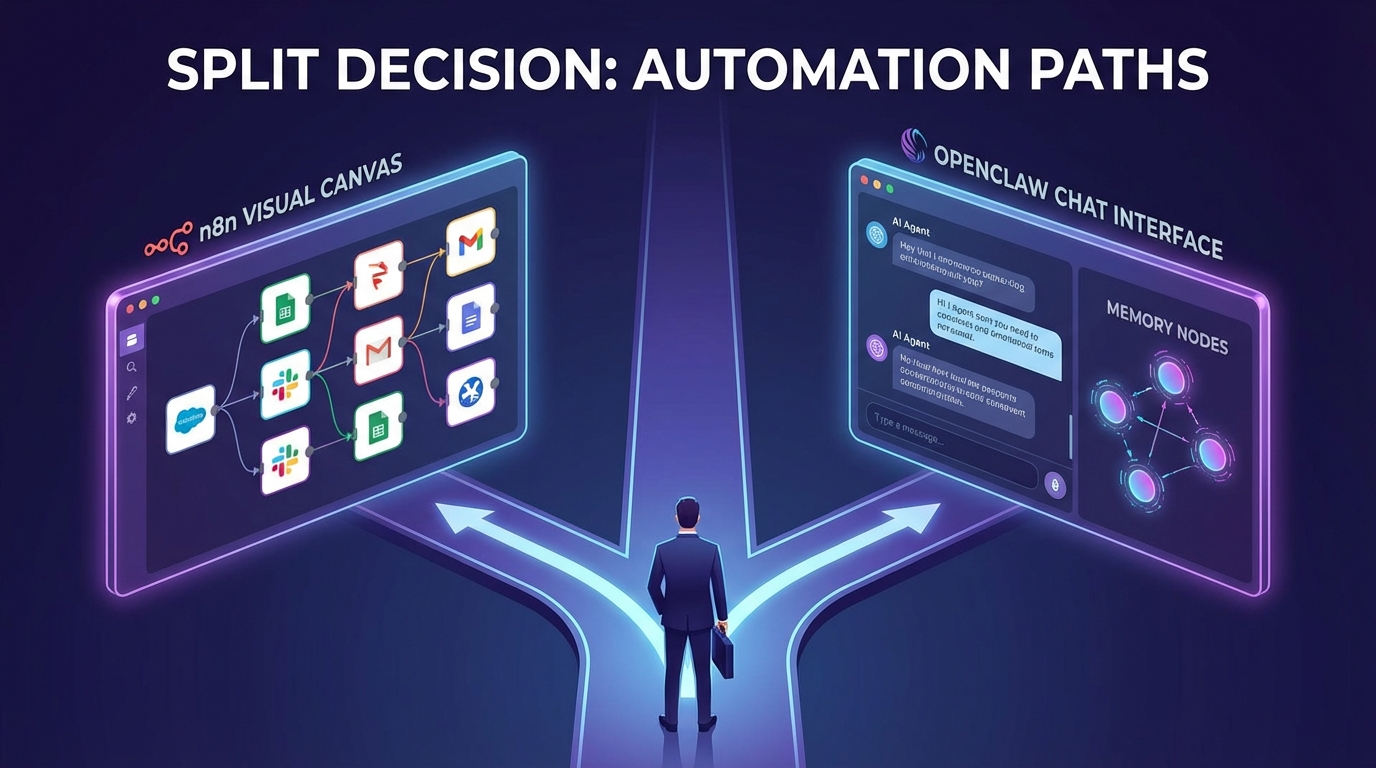
n8n is a mature, well-tested workflow automation platform with a massive integration library and a visual interface that works well for trigger-based, stateless processes.
OpenClaw is an AI agent platform built for tasks that require memory, judgment, and natural language interaction. The persistent context and skill system make it genuinely different from anything n8n does.
If your automation needs are primarily “connect app A to app B,” n8n is likely the better fit. If you need an agent that knows your business, learns over time, and handles complex ongoing tasks autonomously, OpenClaw is worth the setup investment. And if that setup feels like a lot, that is exactly what the OpenClaw setup service exists for.
For a broader look at how OpenClaw stacks up across the AI agent space, the OpenClaw vs ChatGPT vs Auto-GPT comparison covers the full space in one place.
Ready to set up OpenClaw the right way?
Skip the configuration rabbit hole. Get a working AI agent in days, not weeks.