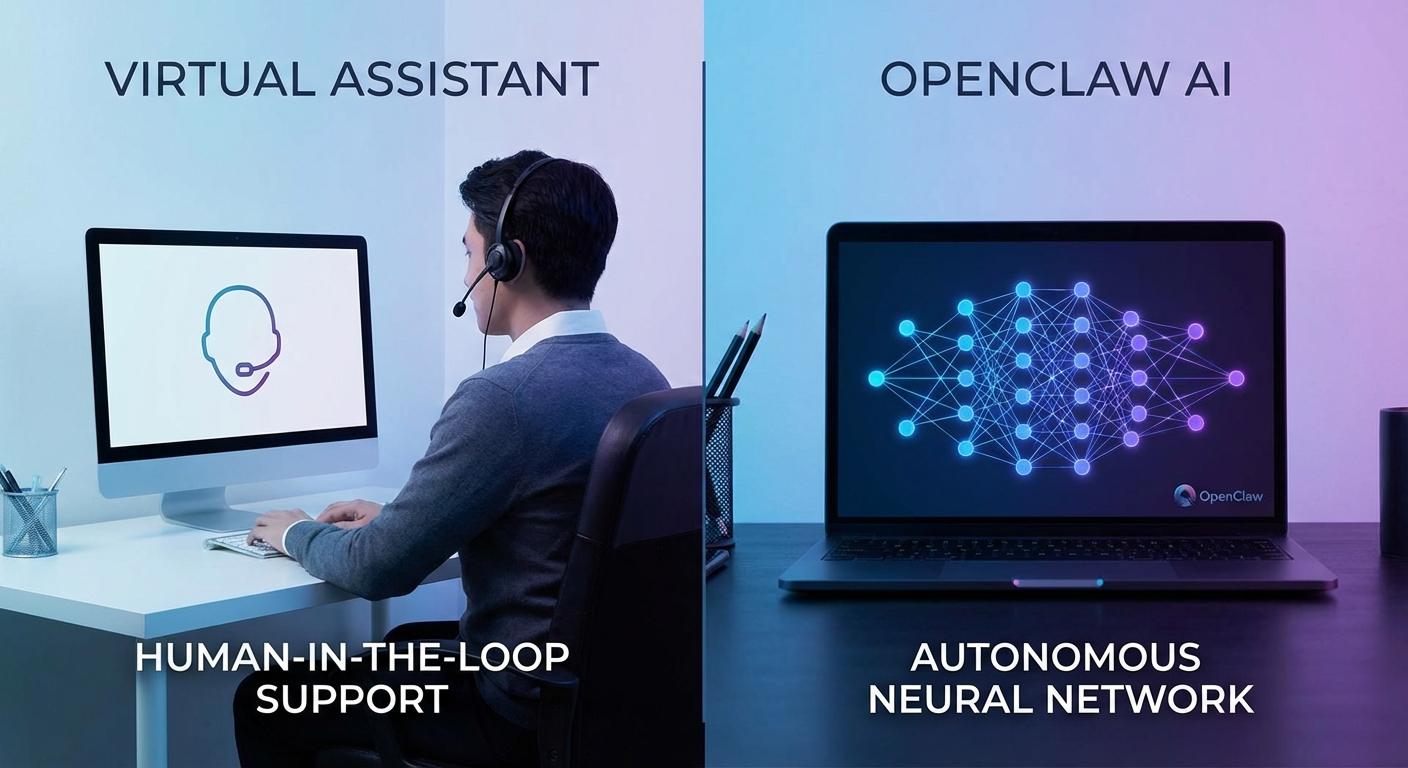
Hiring a virtual assistant costs between $1,000 and $9,600 per month in 2026, depending on whether you go offshore or US-based. That’s $12,000 to $115,200 per year for one person who works set hours, takes vacations, and occasionally ghosts you mid-project. OpenClaw costs nothing to run after setup, works 24/7, and never asks for a raise. So why are business owners still debating openclaw vs hiring virtual assistant as a serious question?
Because the comparison is more nuanced than the sticker price suggests. A human VA can handle ambiguity, read social cues, and make judgment calls that AI still struggles with. OpenClaw can process 500 emails at 3am without complaining. The right choice depends on what you actually need done, how much management overhead you can tolerate, and whether your tasks are repeatable enough to automate.
This breakdown covers the real numbers on both sides so you can make that call with actual data instead of guesswork.
Skip the Comparison. Get OpenClaw Set Up For You.
We build custom OpenClaw assistants for businesses in as little as 48 hours. No DIY headaches.
What a Virtual Assistant Actually Costs in 2026
The numbers vary wildly depending on where your VA is located and how you hire them. Here’s what the data shows across the three main hiring models.
Freelance VAs (Upwork, OnlineJobs.ph, Fiverr): $4 to $30 per hour. Offshore freelancers from the Philippines or Latin America typically charge $4 to $12 per hour. US-based freelancers run $15 to $30 per hour, according to PayScale’s 2026 data showing an average of $19.45/hour for US virtual assistants. The catch is that you manage everything yourself: training, quality control, schedules, and communication.
Managed VA services (Wing, Belay, Time Etc): $1,000 to $3,000 per month for offshore talent, $4,000 to $9,600 per month for US-based, according to Wing Assistant’s 2026 pricing guide. These services handle recruiting, training, and replacement if your VA doesn’t work out. You pay a premium for that management layer.
Full-time in-house hire: $25,000 to $63,000 per year based on Indeed’s salary data from February 2026, which puts the average at $25.82/hour. Add benefits, payroll taxes, and equipment, and the real cost is 20-30% higher than the base salary.
The recurring theme here is “recurring.” Every one of these options is a monthly expense that continues as long as you need the help. Miss a payment, lose your VA. Scale back for a quiet month, you’re still paying the same rate. And if your VA quits? You start the hiring process all over again.
What OpenClaw Costs vs Hiring a Virtual Assistant
OpenClaw’s cost structure is fundamentally different from a virtual assistant because the big expense is upfront, not monthly.
The software itself is open source. You need a Mac Mini (roughly $600-$800), an Anthropic API subscription ($20-$100/month depending on usage), and the time or expertise to configure everything. That last part is where most people get stuck.
DIY setup takes 15 to 40+ hours if you’re technical. If you’re not, you’re looking at significantly longer, or you just never finish. That’s not a knock on anyone’s intelligence. OpenClaw’s configuration involves writing AGENTS.md files, setting up cron jobs, connecting messaging platforms, configuring skills, and troubleshooting API integrations. It’s a real project.
Professional setup through a service like OpenClaw Ready runs $997 for a 2-hour guided session, $4,497 for a full business starter package with 3 automations and team training, or $7,497 for professional-tier with 5-10 automations and 60 days of priority support. Enterprise deployments start at $14,997 and include multi-instance configurations with security hardening.
After setup? Your ongoing cost is just the API usage. For most small businesses, that’s $20 to $100 per month. Compare that to the $1,000+ monthly minimum for even the cheapest managed VA service.
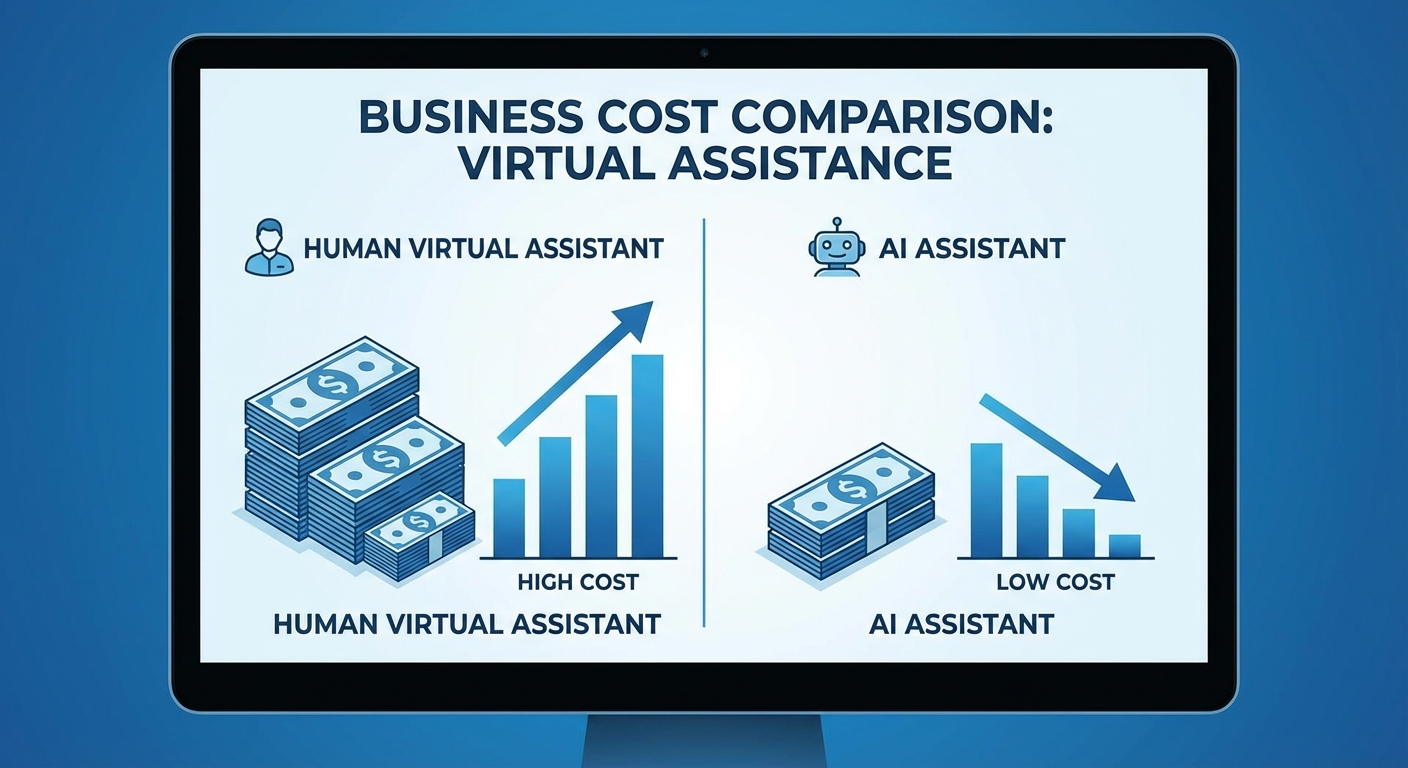
Here’s a simple 12-month comparison. A US-based managed VA at $5,000/month costs $60,000 over the year. OpenClaw with professional setup at $4,497 plus $75/month in API costs totals $5,397 for the same period. That’s a 91% cost reduction. Even an offshore VA at $1,500/month runs $18,000 annually, more than three times the OpenClaw path.
Where OpenClaw Beats a Human Virtual Assistant
The advantages aren’t just about price. Some tasks are genuinely better suited for an AI agent than a human assistant.
24/7 availability. OpenClaw doesn’t sleep. It can monitor your email at 2am, process customer inquiries on weekends, and run automated routines on a schedule without you asking. A human VA works 8 hours a day, 5 days a week, minus sick days and vacations. If your business needs after-hours coverage, you’re either paying overtime or hiring a second VA in a different time zone.
Consistency. An OpenClaw automation runs identically every single time. Your morning briefing, your social media scheduling, your invoice processing. Same format, same thoroughness, same quality at execution #1 and execution #500. Human VAs have good days and bad days, which is normal but introduces variability into critical workflows.
Speed at scale. Need to process 200 customer support emails? A human VA handles maybe 15-25 per hour with thoughtful responses. OpenClaw can work through the entire batch in minutes, categorizing, drafting responses, flagging the ones that need human judgment. For repetitive high-volume tasks, the speed difference is orders of magnitude.
No management overhead. This is the one most business owners underestimate. Managing a VA takes 3-5 hours per week: assigning tasks, reviewing work, giving feedback, handling miscommunications, covering for absences. That’s your time, and it has a cost. OpenClaw runs on its own once configured. You check the output, not the process.
Instant scaling. Need your VA to handle three new workflows? That’s a conversation about capacity, maybe a rate increase, possibly hiring a second person. With OpenClaw, you add a new skill or cron job. The marginal cost of adding a new automation is essentially zero.
A Fraction of VA Cost. Full 24/7 Coverage.
Businesses running OpenClaw spend $5,400/year instead of $60,000 on US-based virtual assistants. Setup takes 48 hours, not 48 interviews.
Where a Human VA Still Wins
Honesty matters here. OpenClaw can’t do everything a human can, and pretending otherwise would waste your money.
Complex judgment calls. If a client emails with a vague complaint that requires reading between the lines, understanding their history with your company, and crafting a response that salvages the relationship – that’s human territory. AI can draft a response, but the emotional intelligence and contextual judgment of an experienced VA is hard to replicate.
Unstructured creative work. Planning a corporate event, coordinating with multiple vendors, negotiating prices, and handling the dozen unexpected problems that come up? A good VA thrives here. These tasks require adaptability that goes beyond what even the best AI agent handles well right now.
Phone calls and live interaction. Scheduling appointments by phone, following up with leads via voice calls, or sitting in on meetings to take notes and action items. OpenClaw can transcribe and summarize after the fact, but it can’t pick up the phone and charm a difficult vendor into giving you a better rate.
Tasks that change constantly. If your needs shift week to week with no predictable pattern, a human VA adapts naturally. They ask clarifying questions, pick up on your preferences over time, and handle “just figure it out” requests. OpenClaw needs defined workflows. If the task can’t be described as a repeatable process, it’s probably better for a human.
The honest assessment is that roughly 60-70% of what most businesses hire VAs for – email management, scheduling, data entry, social media posting, research, report generation – falls squarely in OpenClaw’s wheelhouse. The remaining 30-40% still benefits from a human touch.
The Hybrid Approach: OpenClaw Plus a Part-Time VA
A move that makes more sense for many businesses isn’t choosing one or the other. It’s using both strategically.
Automate the repetitive, high-volume tasks with OpenClaw: email triage, content pipeline automation, calendar management, data processing, and routine customer communications. Then hire a part-time VA for 10-15 hours per week to handle the human-judgment tasks: client relationship management, creative projects, phone calls, and anything that requires reading a room.
The math on this approach is compelling. Instead of a full-time VA at $5,000/month, you run OpenClaw ($75/month in API costs) plus a part-time VA at 15 hours/week for $1,200/month. Total: $1,275/month versus $5,000. You get better coverage on the automated tasks (24/7 instead of business hours only) and your human VA can focus entirely on the work that actually requires a person.
Some business owners describe this approach as “promoting” their VA. Instead of spending half their time on data entry and email sorting, the VA now does exclusively high-value relationship work while OpenClaw handles the grind.
OpenClaw vs Hiring a Virtual Assistant: Head-to-Head Breakdown
Here’s how the two options compare across the factors that matter most to business owners.
Monthly cost: OpenClaw runs $20-$100/month after setup. A managed VA costs $1,000-$9,600/month depending on location and service tier.
Setup time: OpenClaw takes 2-8 hours with professional help, or 15-40+ hours DIY. Hiring a VA takes 2-6 weeks including posting, interviewing, and onboarding.
Availability: OpenClaw works 24/7/365. A human VA works 20-40 hours per week with time off.
Scalability: Adding new tasks to OpenClaw is a configuration change. Adding tasks to a VA means renegotiating hours or hiring another person.
Task flexibility: VAs handle unstructured, ambiguous, and interpersonal tasks far better. OpenClaw excels at structured, repeatable, high-volume work.
Reliability: OpenClaw runs the same way every time. Human VAs vary in quality, mood, and availability. But OpenClaw can’t improvise when something breaks outside its programming.
Management required: OpenClaw needs initial configuration then minimal oversight. A VA needs 3-5 hours of management per week on average.
Replacement risk: If your VA quits, you lose institutional knowledge and start over. OpenClaw’s configuration is saved in files that don’t resign.

How to Decide Which Option Fits Your Business
The openclaw vs hiring virtual assistant decision comes down to a handful of questions. Run through them and the answer usually becomes obvious.
Are most of your tasks repeatable with clear inputs and outputs? If yes, lean OpenClaw. If your tasks are different every day with lots of gray area, lean human VA.
Do you need after-hours coverage? OpenClaw doesn’t cost extra at 2am. A second-shift VA does.
How much time are you spending managing your current VA? If the answer is “too much,” automating the structured tasks with OpenClaw frees both of you.
What’s your monthly budget? Under $500/month, OpenClaw is your only realistic option for meaningful assistance. $500-$2,000, consider OpenClaw plus a few hours of human help. Over $2,000, you have room for the hybrid approach that covers everything.
Are you technical enough to set up OpenClaw yourself? If not, factor in professional setup costs. Even at $4,497 for the business starter tier, you break even against a managed VA in under two months.
Ready to Replace Your VA’s Busywork?
Our Business Starter package ($4,497) sets up 3 custom automations, trains your team, and includes 30 days of email support. Break even in under 2 months vs a managed VA.